
Content Strategy Examples That Actually Work (and How to Steal Them)

What if most “content strategies” you admire are just polished guesses? You’ve read the lists, bookmarked the templates, and tried to copy them, only to end up with half-baked results and tired metrics.
Content strategy examples should do one thing: Prove they work.
According to Content Marketing Institute’s 2025 B2B trends, 61% of B2B marketers plan to increase investment in video next year, while many also double down on thought leadership.
In this post I’ll show practical playbooks (not theory), the exact tools and workflows teams use, and how to measure whether a strategy is actually delivering. Steal the frameworks that scale, avoid the traps that make “strategy” a shelf-filler, and use the mini-templates at the end to get moving.
By the end you’ll have a repeatable playbook and a 30-day test you can run next week.
What Is A Content Strategy And Why It Matters
A content strategy is the plan that ties what you publish to a business outcome. It answers who you’re trying to reach, what change you want to create, and how you’ll measure progress.
Without that thread you get content for content’s sake—nice-to-read but not business-useful. Good strategies orient on audience intent and a small set of KPIs (traffic, leads, retention).
Think of it like a recipe: ingredients (formats), timing (distribution), and the taste-test (metrics). If you can’t say what success looks like in a single sentence, your “strategy” is probably a to-do list.
Key Elements of Successful Content Strategies
Every repeatable strategy has the same core parts: clear goals, an audience map, a content audit, a format mix, and distribution channels.
Start with goals—what metric moves the needle for your team?
Then audit: inventory what you already have, what works, and where gaps exist. Choose a format mix that matches the audience and channel—blogs for long intent, short video for social, guides for mid-funnel conversion.
Distribution matters more than most teams admit: good content with no push equals wasted effort.
Quick checklist: Goal → Audit → Map formats → Publish cadence → Distribution plan → Measurement.
Real Content Strategy Examples You Can Learn From

Below are five condensed playbooks you can replicate quickly. Each focuses on one outcome and the core moves that delivered it.
Blog-First Growth Playbook: Build Traffic with Clusters
This playbook on content strategy examples centers on topical clusters and pillar pages that capture buyer intent. Teams create a pillar + supporting posts, optimize internal linking, and focus investment on organic search until the topic gains traction.
The payoff: steady organic traffic that reliably feeds lead-gen offers and scales over time. For a practical look at brands that used cluster-based approaches to boost relevance and traffic, see Siege Media’s roundup of real examples and frameworks.
Multi-Channel Strategy: Repurpose One Idea Across Formats
Web content strategy examples playbook turns one deep idea into multiple touchpoints: a long-form article, short social clips, an email thread, and maybe a gated guide. The trick is efficient repurposing—each format amplifies the core insight rather than rewriting it. That coordinated cadence drives repeated exposure without multiplying workload.
Outbrain’s guide on multichannel content explains how top teams schedule and repurpose to increase reach while avoiding duplication.
B2B Strategy: Content Aligned to the Buying Cycle
B2B content marketing examples often map content to buyer stages—awareness, evaluation, decision—and measure impact on pipeline, not vanity metrics. Tactics include case studies, product walkthroughs, and educational webinars tied to MQL and pipeline influence metrics.
- FullFunnel / Sales Hacker (case) — By targeting lower-competition keywords and building conversion paths matched to intent, the team reported roughly 268% growth in organic traffic in six months. Use this as proof that precise targeting + conversion mapping outperforms content volume alone.
- Wingtra / HubSpot (case) — Wingtra used an experimentation-first workflow and HubSpot’s stack to accelerate tests. After focused experiments and workflow changes they achieved about 40% uplift in conversions within four months. This shows the power of tight experiments + a measurement-first approach.
Enterprise Strategy: Managing Content at Scale
When scale matters, strategy becomes about governance, taxonomy, and maintenance. Big teams invest in content libraries, strict editorial governance, and ongoing competitive audits to keep content useful and discoverable.
Dusted’s enterprise case studies (Splunk, Blackstone) reveal how larger orgs manage scale and SEO at the same time—useful templates for teams moving beyond one-off campaigns.
Comparison Table: Content Strategy Playbooks at a Glance
| Playbook | Goal | Time to Impact | Core Tactics |
| Blog-first growth | Steady organic traffic & lead-gen | 4–6 months | Pillar + cluster posts, internal linking, SEO-driven topics |
| Multi-channel digital | Reach + retention across touchpoints | 1–3 months | Repurpose core research into blog, social, email; coordinated publishing |
| B2B content marketing | Pipeline growth & sales enablement | 4–6 months | Stage-based content: case studies, product walkthroughs, webinars |
| Enterprise-scale strategy | Governance + scalability of large catalogs | Ongoing (long-term) | Content library management, taxonomy, governance, competitive audits |
| Case-driven B2B (Wingtra / SalesHacker) | Conversion lift & traffic acceleration | 3–6 months | Keyword targeting, content experiments, workflow optimization |
Tools & Workflows for Stronger Content Strategy
Think of this as “how you actually ship.” Tools are useful, but the real win is a simple, repeatable workflow and clear ownership. Below is a minimal stack, a lean execution loop, and pocket checklists you can use today — no fluff, just the plumbing that makes strategy repeatable.
Minimal tool stack
- Publishing / CMS — WordPress, Webflow, or your CMS of choice. This is where content lives.
- Analytics — GA4 + a simple dashboard (Looker Studio or your analytics tool) so you can answer: did it move the metric?
- Editorial calendar — Notion / Asana / Trello — one source of truth for topics, owners, and deadlines.
- SEO research — SEMrush / Ahrefs for keyword maps and gap checks.
- Brief & templates — simple docs (one-sentence brief, SEO checklist, promotion plan) that force consistency.
You don’t need every tool. Instead, pick one in each category and make it work for the team.
A clean, repeatable workflow
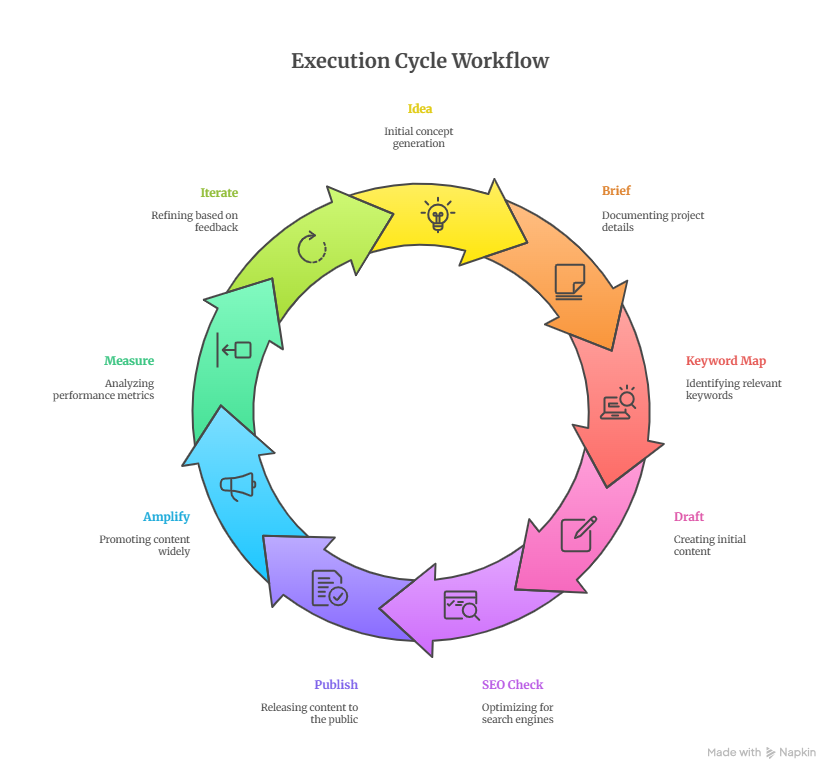
- Idea — log it in the calendar. What to check: Does it map to a KPI?
- One-sentence brief — audience, primary problem, one outcome. Check: Is the outcome measurable?
- Keyword map — PK + 3–6 SKs and intent. Check: Does intent match the angle?
- Draft — writer follows brief + SEO checklist. Check: Is the hook strong and CTA clear?
- SEO check — meta, headings, internal links, schema. Check: PK in H1 and intro?
- Publish — upload, set meta/OG, schedule promotion. Check: images optimized + alt text done.
- Amplify — email, social, partnerships, syndication. Check: at least two channels scheduled.
- Measure — cohort metrics, experiment results. Check: baseline captured, lift recorded.
- Iterate — refresh, prune, scale winners — then loop back to Idea.
This is a cycle, not a checklist. Finish step 9 and it feeds new ideas into step 1.
Pocket templates
- One-sentence brief (required): Audience — problem — one outcome.
Example: “Ecommerce marketing managers — poor open rates — increase email signups by 15% via content gating.” - 5-point SEO checklist (required before publish): H1 contains PK, meta ≤60 chars, 1–2 internal links, images optimized + alt text, schema where relevant.
- Promotion plan (one-paragraph): Where to share (email, LinkedIn, Twitter/X), 2 repurposes (short clip + carousel), 2 partners/outreach targets.
Governance
Use a tiny RACI for each piece (so things don’t die in review):
- Responsible = Writer / producer.
- Accountable = Editor / owner.
- Consulted = SEO / Subject Expert.
- Informed = Distribution / Stakeholders.
One sentence per piece in your calendar: who’s R/A/C/I and the publish date. That alone prevents handoff chaos.
AI in the stack
AgencyAnalytics 2025 benchmarks show rapid adoption of AI across workflows—teams use AI for research, first drafts, and repurposing so humans focus on judgment and quality.
- Use AI to speed research, generate first drafts, and create repurposing variants.
- Don’t rely on it for final edits, examples, or claims — always add human judgment and fact checks.
- Keep a human reviewer for tone, accuracy, and brand voice.
How to Measure and Verify Content Strategy Examples

Measuring content isn’t about collecting vanity numbers. It’s about proving whether the content moves a business metric you care about. Start small: pick one primary KPI per playbook, capture a baseline, run a short test, then decide to scale, tweak, or kill. Below are the practical KPIs, quick measurement methods, and a repeatable experiment template you can use for any playbook.
Primary KPIs by playbook
- Blog-first growth — organic sessions → leads. Supporting metrics: keyword rankings, organic CTR, time on page, assisted conversions.
- Multi-channel digital — repeat visits or email list growth. Supporting metrics: impressions, engagement rate on social, newsletter open/click rates, returning user share.
- B2B content marketing — MQLs or pipeline-influenced leads. Supporting metrics: demo requests, webinar signups, content-assisted pipeline value.
- Enterprise-scale strategy — catalog health. Supporting metrics: indexed pages, top-page organic sessions, internal link equity, content decay rate (pages losing traffic).
Pick one KPI as primary before you publish anything. The rest are supporting evidence.
Experiment template (copy/paste box)
Hypothesis — “If we change [X], then [Y] will increase by [Z]% in [time].”
Variable — One change only (e.g., CTA copy, headline, meta title).
Sample — Pages you test on (top 5 posts in one cluster).
Primary metric — The KPI you measure (conversions, signups, demo requests).
Duration — 14–30 days depending on traffic.
Control — Keep a similar set of pages unchanged (or A/B test if supported).
Success criteria — +10% uplift or statistically significant win.
Next step — Roll out to top 20 pages if it works; revert and test a new variable if it doesn’t.
Dashboard view (what to show the team)
Your dashboard should answer “is this working?” in 5 seconds. Keep it simple:
- Line chart — sessions & conversions trend over 30 days.
- Funnel chart — page views → CTA clicks → conversions.
- Bar chart — test vs control uplift.
Place your dashboard mockup image here so readers can visualize what success tracking looks like. (Alt text: “Dashboard showing content performance KPIs with line, funnel, and bar charts.”)
Cadence & next steps
- Weekly — quick check on trends and experiment health.
- Monthly — review primary KPI vs baseline; decide whether to scale or prune.
- Quarterly — run a full content audit: refresh winners, merge or cut low performers.
This cadence keeps your feedback loop tight and prevents “publish and pray.”
Many publishers and marketers now pair AI with measurement—over 80% of marketers report using AI tools in some part of their workflow, which changes how you scale tests and analyze results. Use benchmarks but treat them as directional, your experiments tell the true story.
30-Day Experiment Template
Title: 30-Day Content Test — Quick Template
- Hypothesis
- Example: “If we update the hook and CTA on 5 top-performing pages, average conversion rate will rise by 10%.”
- Example: “If we update the hook and CTA on 5 top-performing pages, average conversion rate will rise by 10%.”
- Variable
- What you’ll change: Hook copy / CTA text / Featured image / Meta title (pick one).
- What you’ll change: Hook copy / CTA text / Featured image / Meta title (pick one).
- Sample
- Which pages: Top 5 pages by traffic that are relevant to the same topic cluster.
- Which pages: Top 5 pages by traffic that are relevant to the same topic cluster.
- Metric (Primary)
- e.g., conversions per session (or clicks to lead form).
- e.g., conversions per session (or clicks to lead form).
- Supporting metrics
- Sessions, time on page, scroll depth, bounce rate.
- Sessions, time on page, scroll depth, bounce rate.
- Test window
- 14–30 days depending on traffic (14 days for high traffic pages; 30 if low).
- 14–30 days depending on traffic (14 days for high traffic pages; 30 if low).
- Control & roll-out
- Keep control pages unchanged. If A/B testing isn’t available, run variant on alternate pages and compare cohorts.
- Keep control pages unchanged. If A/B testing isn’t available, run variant on alternate pages and compare cohorts.
- Success criteria
- Minimum 10% relative lift in primary metric vs baseline (or statistically significant uplift if you can calculate).
- Minimum 10% relative lift in primary metric vs baseline (or statistically significant uplift if you can calculate).
- Next steps if success/failure
- Success: roll out change to top 20 pages and monitor for 30 days.
- Failure: revert and test a new variable (image, CTA, or headline).
- Success: roll out change to top 20 pages and monitor for 30 days.
Iteration in Content Playbooks: How to Refresh, Prune, and Scale
A content strategy isn’t “set it and forget it.” The work compounds only if you keep tuning. Iteration means three things: refresh what’s working, prune what isn’t, and scale what proves itself.
Refresh winners
- Update posts that already pull traffic or conversions.
- Add new stats, screenshots, or quotes.
- Improve structure: subheads, tables, FAQs.
- Refresh every 6–12 months or sooner if rankings slip.
Treat winners like assets — maintain them before they decay.
Prune low performers
Not everything deserves to stay live. Use these quick rules:
- <100 sessions in 90 days and no backlinks → prune or merge.
- Thin content (<500 words) with no conversions → expand or delete.
- Duplicate or cannibalizing pages → consolidate into one stronger asset.
Pruning is healthy — it sharpens your catalog and improves crawl efficiency.
Scale proven playbooks
Once an experiment works, roll it out:
- Expand a pillar page with more supporting posts.
- Repurpose a strong webinar into clips, carousels, and a guide.
- Double down on one distribution channel (email, LinkedIn, YouTube) where you see repeat ROI.
Cadence to keep the loop alive
- Monthly — check top 10 pages: update if slipping.
- Quarterly — prune deadweight content.
- Yearly — realign playbooks with business goals.
Iteration isn’t glamorous, but it’s where strategies become durable. Keep the loop tight, and your catalog turns into an asset — not a landfill.
Common Pitfalls And How To Avoid Them

Here are the common mistakes teams make and how to fix them:
- No measurable goal → Fix: pick one KPI and align content to it.
- Copying competitors blindly → Fix: audit gaps and add original examples/experiments.
- Ignoring distribution → Fix: plan promotion before you publish.
- Bad measurement → Fix: define success metrics and testable hypotheses.
- Publishing without governance → Fix: create a lightweight approval process.
Quick Templates for Content Marketing Examples
Here are concrete templates and next steps you can use immediately to move your content strategy from plan to action:
| Template | Purpose | What to Fill In Immediately |
| SMART Goals Template | To set measurable goals tied to business outcomes. | Business goal + 3 specific content goals (e.g. increase organic traffic 30%, get 50 MQLs per month, reduce bounce rate by 15%). |
| Editorial Calendar Template | To plan out content cadence & responsibilities. | Months ahead; specify topic, format, owner, due date, and channel of promotion. |
| Content Audit / Inventory Template | To assess existing content, repurpose winners, and prune underperformers. | List current content (URL, format, performance metrics), what to keep/update/prune. |
| Buyer Persona & Voice Guide Template | To align content voice, tone, and messaging with target audience. | Define 2–3 personas, give them names + traits; choose 3 adjectives for your brand voice. |
| Experiment / A/B Test Template | To test one change, measure it, and decide scale or drop. | Hypothesis + variable (what to change) + metric to track + control group + test period. |
Next Steps (Action driver)
- Pick one or two templates above to fill out this week (for example: SMART Goals + Content Audit).
- Use your new comparison table of playbooks to decide which strategy feels most aligned with your resources and goals (blog-first vs multi-channel vs B2B vs enterprise).
- Publish one example case or experiment from your strategy so you can start measuring and iterating immediately.
- Share your editorial calendar with someone (team, colleague) or get alignment — part of governance.
- Set your first measurement checkpoint (30 days): decide which metrics you’ll track (traffic, engagement, conversions), capture current baseline, and commit to experimenting.
Key Takeaways
- Pick one playbook — blog-first, multi-channel, B2B, or enterprise — don’t try to run all four at once.
- Tie it to a KPI — content strategy examples only matter if you can prove impact (traffic, leads, or retention).
- Run a 30-day test — change one variable, measure one metric, and decide whether to scale or scrap.
- Refresh winners, prune losers — update high performers every 6–12 months; cut pages that show no traction.
- Keep the loop short — weekly checks, monthly reviews, quarterly audits. Iteration beats “publish and pray.”
Why these work: They’re action-first: each line tells the reader what to do and how to measure.
They echo your differentiators (playbooks, measurement, iteration, governance) so the takeaways reinforce the article’s unique value. These content strategy examples are only useful if tied to KPIs
FAQ
A good content strategy example ties a clear business outcome (e.g., leads or retention) to a repeatable playbook and shows evidence it worked — not just a list of tactics.
Expect measurable improvement in 4–6 months for SEO-driven plays; social or short-form experiments can show earlier signals. Results depend on traffic baseline and promotion.
Start small: sessions (or impressions), one engagement metric (time on page or scroll depth), and one outcome metric (leads, signups, or conversions).
Yes — but smart small teams pick one repeatable playbook, test fast, and repurpose content across channels rather than trying to match volume.
Review your catalog quarterly; refresh pages that show momentum and prune content that never gains traction after controlled tests.
Pick one CMS, one analytics stack, one calendar, and one SEO tool , start small and expand later.
Ready to try it? Pick one of the playbooks above, set a KPI, and run the 30-day test. See what happens, then refresh or prune based on results. If you’ve got questions or want to share what worked, drop a comment or reach out on my contact page.

I write for marketers and creators who want a smarter, more human perspective on AI and digital marketing. My goal is to challenge assumptions, make people think differently, and show how strategy beats cookie-cutter advice.